

Founded in Boston in 2006 as a marketing software company, HubSpot quickly rose to become a global leader in customer relationship management (CRM).
Renowned for its innovative approach, HubSpot has also become a pioneer in flexible work arrangements. The company offers employees a choice of three work styles: fully remote (@home), office-based (@office), or a hybrid of the two (@flex).
Let’s explore how HubSpot’s distributed teams successfully collaborate in this hybrid environment and uncover valuable insights for other organizations looking to adopt similar models.
How Hybrid Works for HubSpot
As mentioned earlier, there are 3 types of work arrangements inside HubSpot:
- @home: Remote employees will typically work from home. While they may visit a HubSpot office once or twice a quarter, their home serves as their primary workspace. HubSpot is committed to providing remote employees with the resources and support needed for a productive and comfortable home office setup.
- @office: For those who prefer the @office work style, HubSpot provides a dedicated desk in one of its global offices. Employees in this category come in at least three days per week, allowing them to personalize their workspace with their laptop, monitor, plants, and other personal items. Given their office-based setup, @office employees do not receive a home office stipend.
- @flex: Employees who opt for the @flex work style come into a HubSpot office no more than two days per week. They use shared “hotel desks” during their office visits. To support their flexible arrangement, HubSpot offers resources to help set up a productive home office.
Back in 2021, here’s how the HubSpot employees worked: 39% @home, 43% @flex, and 18% @office.
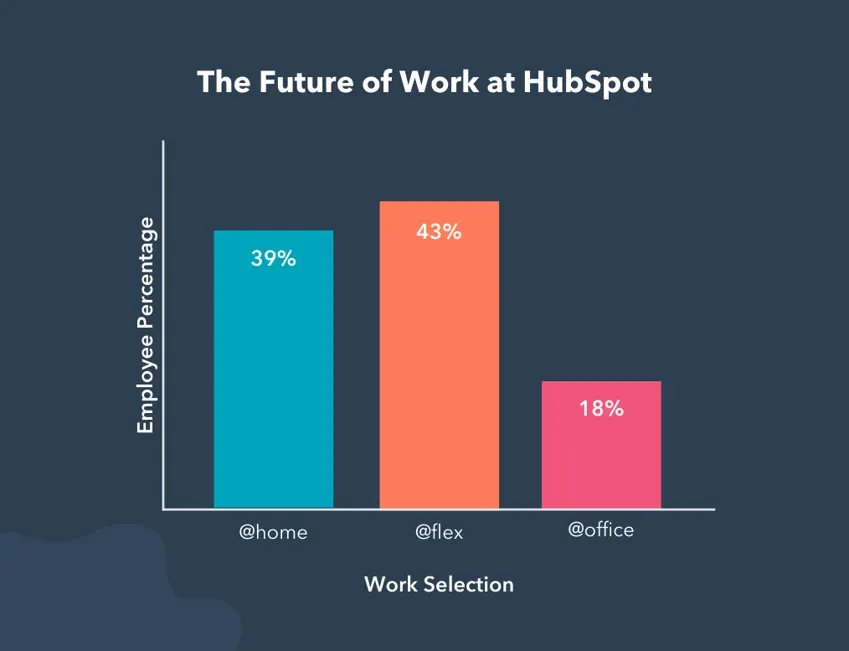
Fast forward, in 2023, the data looks a whole lot different: 63.4% @home, 28.3% @flex, and 8.3% @office.
“Culture does not need four walls to thrive.”
Eimear Marrinan | Sr. Director of Culture, HubSpot
At the end of the day, HubSpot’s culture is defined by its values, people, and mission, not location. Employees can experience HubSpot’s culture regardless of where they work.
Now, let’s take a look at some inspiring best practices from HubSpot, when it comes to handling hybrid work.
Key strategy 1: Enhance the new hire experience
- Provide comprehensive onboarding resources: Equip new hires with the necessary tools, information, and support to succeed in a hybrid environment.
- Increase asynchronous work options: Allow new hires to complete tasks and learn at their own pace, providing flexibility and reducing stress.
- Foster a welcoming and inclusive environment: training is happening in smaller teams, with multiple facilitators, so that there is more time for questions, and everyone can feel heard.
Key strategy 2: Organize engaging events
Instead of trying to recreate the traditional office environment, teams should focus on developing intentional, creative solutions that are tailored to the hybrid work model.
“Despite living in a world where social media and technology is at our fingertips, employees feel more disconnected than ever. But we’ve learned that the quantity of interaction doesn’t equate to the quality of high connection. Employees are seeking more meaningful ways to connect in-person and online, rather than simply more ways to communicate. That’s why we’ve tried to help employees rebuild their community and deepen their connections through hybrid initiatives like Bring Your Family to Work Day or our Great Ice Cream Social. “
Eimear Marrinan | Sr. Director of Culture, HubSpot
- Instead of trying to replicate things employees used to do and moving them in Zoom (e.g.: online happy hours) HubSpot is taking people to places where even in person it would be difficult to attend (e.g.: graffiti class with an artist in Spain). The message here is to offer unique experiences that are memorable and build connections.
- Collaborate with external experts: Invite guest speakers or facilitators to share their insights and expertise, providing new perspectives and inspiration.
- Reduce uncertainty and stress: Minimize confusion and anxiety by providing clear information and support. HubSpot has templates for managers that look like this: “success in 30 days looks like (list here), some norms of our specific team are (X,Y,Z), if you’re lost, the best place or person to ask is here or we have a weekly water cooler at X time.” Often employees might have a FOMO feeling (fear of missing out), because some are working remotely, some are in the office. Clarity is essential here, so that employees know what to do, and who to talk to in case of any need.
Key strategy 3: Ensuring equity
Sadly, there are organizations where those that work from the office are favored compared to the ones working from home. This can lead to unfair promotions and rewards for office-based employees. This has a name in cognitive psychology: proximity bias.
To mitigate this risk HubSpot:
- Avoids level or tenure requirements: Employees are ensured that there are equal opportunities regardless of location.
- Addresses proximity bias education: HubSpot creates awareness around the topic and educates teams and managers on how to manage proximity biases. HubSpot is also measuring promotion velocity by work and new hire work preferences to identify if proximity bias takes place.
- Create an inclusive culture: Model inclusive behavior and provide accessibility accommodations.
Key strategy 4: Handling legal and tax requirements
Globally, there are nine HubSpot entities. These are the only locations where HubSpotters can work remotely from. Other locations might be added in the upcoming years.
Now, here’s how HubSpot handles ensures compliance with hybrid work legal requirements:
- People ops, finance, tax, mobility, and employment law teams work closely together to ensure they are compliant in their approach to hybrid work, because laws change very often.
- HubSpot is also offering** **stipends and support for remote work. These stipends can vary by location, but the info is provided clearly and transparent.
Key strategy 5: HubSpot’s approach to time zones in a hybrid work environment
The key here is flexible working hours.
- Role-specific requirements: Certain roles, such as customer support positions, may have specific working hour expectations to ensure best service delivery. For example, employees hired to work West Coast hours on the Support team may be expected to align their schedule with the hours followed by customers in the Pacific Time Zone. However, this does not prevent individuals from other time zones, such as the Midwest or East Coast, from applying for these roles. There are various reasons, including caregiving responsibilities or partner schedules, why someone might prefer a different working arrangement.
- Transparent communication: HubSpot ensures that required working hours are clearly communicated to candidates throughout the job description and recruitment process, providing transparency and allowing individuals to make informed decisions.
- Flexibility for most roles: Most roles at HubSpot do not have strict working hour requirements, offering employees greater flexibility in managing their schedules. This allows individuals to balance their work commitments with personal obligations and preferences.
How is HubSpot Measuring the Success of Its Hybrid Work Model?

HubSpot regularly measures employee satisfaction using the Employee Net Promoter Score (eNPS). By tracking eNPS by team and including questions on global inclusion, team connection, and asynchronous communication, HubSpot can gain valuable insights into the effectiveness of its hybrid work model.
To ensure ongoing improvement, HubSpot’s People Analytics and Culture teams regularly update the survey questions to delve deeper into employee experiences. The survey results are then published company-wide, fostering transparency and encouraging employee feedback. By analyzing team and location-level trends, HubSpot can quickly identify and address any issues that may arise.
HubSpot has also invested in creating content to equip managers with the necessary skills to lead hybrid teams effectively. This targeted approach ensures that managers have the tools and resources they need to foster a successful and inclusive work environment.
Lessons from HubSpot’s Hybrid Work Journey
One of the most surprising lessons HubSpot has learned throughout its transition to a hybrid work model is the importance of avoiding assumptions. Initial hypotheses about regional breakdowns for work preferences were proven incorrect, emphasizing the value of directly asking employees for their preferences rather than relying on assumptions.
Another key lesson is the necessity of overcommunication. In a hybrid environment with multiple time zones, work preferences, and team operating systems, effective communication is crucial to prevent messages from getting lost. HubSpot has invested significant effort in improving internal communications and ensuring that information is sent effectively at scale.
For leaders, visibility and authenticity have become more important than ever. HubSpot has increased the frequency of AMAs (Ask Me Anything) sessions, including regional ones, and used video platforms like Loom to allow employees to see and hear directly from leaders. These practices have proven effective in fostering a strong connection between leadership and employees and are likely to continue in the future.
“Our goal is to build an equitable, sustainable, and high performing hybrid company. To do that, we want to create intentional space for employees to share more about themselves as humans and to connect across teams.”
Katie Burke | Chief People Officer, HubSpot
Want to read more inspiring stories on how to make remote and hybrid work, work? Check out the Dropbox virtual first story, and the Atlassian distributed teams story.
Now, if you want to find out more about how to manage hybrid workplaces, we’ve created a very thorough guide for you. So, make sure to check Mastering Hybrid Work out!