

Tidaro’s monthly digest brings you the latest happenings in the ever-evolving world of work. We’ll explore trends in workplace management, get insights into the future of work, and discover what’s shaping employee experience today.
Zoom’s Latest Research on Hybrid Work: Productivity, Connection & HR Tech Stack
Zoom and Reworked INSIGHTS announced the results of a survey, titled, “Navigating the Future of Work: Global Perspectives on Hybrid Models and Technology.”
Here are some takeaways from the survey:
- Hybrid work is emerging as the preferred global workstyle.
- 83% of employees find themselves more productive in hybrid or remote environments than in-office settings.
- 75% of employees agree that their organization’s current tools and technology for remote work need improvement.
- 64**%** of employees strongly or slightly agree that “generative AI makes it easier to do my job.”
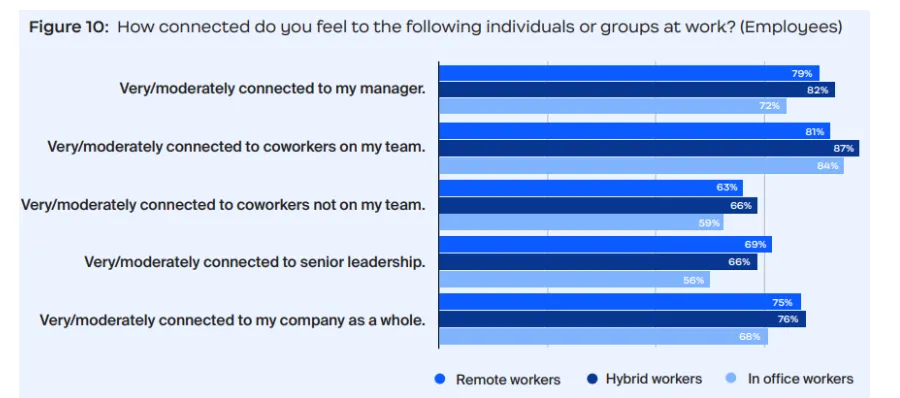
- The benefits of hybrid work extend beyond flexibility, with employees feeling a stronger connection to their teams and managers.
WFH Research Updates – August 2024
WFH Research does a monthly survey in the US with the title: The Survey of Working Arrangements and Attitudes. It started in May 2020. The target of he survey is working US residents, aged 20 to 64. The survey is ran jointly by the University of Chicago, ITAM, MIT, and Stanford University.
Here are some of the survey’s conclusions for August 2024:
- About 28% of the paid days in the US in August 2024 were work-from-home days.
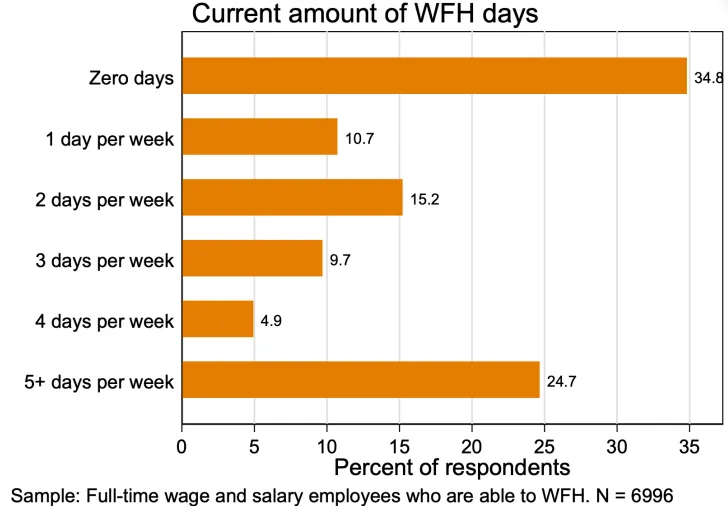
- Employer plans for WFH trend near 2.2 days per week for persons able to work from home.
- The gap between how much employees want to work from home and employer plans fluctuates near 0.5 days.
- By mid-2024: 12% of full-time employees were fully remote, 61% were full-time on-site, and 27% were in a hybrid arrangement.
- Information, finance & insurance, and professional & business services have the largest share of hybrid and remote workers.
HR Tech 2025 – AI Redefines the Landscape
AI is rapidly transforming HR technology. Major HR vendors are integrating AI into their core platforms, offering features like intelligent agents, generative capabilities, and improved user experiences. AI-powered tools are also being used for recruitment, development, employee experience, and career management. This trend is expected to continue, with more AI-driven innovations in the HR space.
Now, here are some of the takeaways for the 2025 outlook on HR tech, from the Josh Bersin Company research:
- Core HR platforms are evolving to include intelligent agents and generative features. Mid-market customers will benefit from AI-powered assistants that streamline employee self-service tasks.
- Talent intelligence teams will gain importance, and many ATS/recruitment tools will incorporate AI agents and advanced talent intelligence features. Leading talent intelligence platforms like Eightfold AI, Gloat, and SeekOut will dominate the market, and major companies like Workday, SAP, and Oracle may acquire these vendors to expand their own offerings.
- Talent marketplace platforms may expand their offerings to include learning experience platform (LXP) capabilities, providing learning opportunities alongside other gig work features. As HCM vendors aim to match this functionality, these platform companies may become acquisition targets.
- AI will revolutionize L&D, transforming traditional LMSs, LXPs, and other development tools. L&D teams will focus on integrating knowledge management into their employee-facing systems. Functional academies will continue to expand, and CLOs will collaborate with other teams to develop AI agents that assist content producers. L&D teams will partner with business units to integrate learning into their business processes through these agents. AI-driven simulations, voice, video, and virtual characters will become more prevalent, with VR gaining importance.
- The EX and employee assistant space will be booming in 2025, with Microsoft, ServiceNow, and others launching more assistants. Now is the time to strategize and build a team to manage these agents. IT involvement is essential, as the EX agent will likely be used across many applications, including IT help, security, and facilities. This is also an opportunity to rethink employee portals.
Amazon Will Return Fully to Office
Andy Jassy, CEO of Amazon, sent an email to employees outlining changes to the company’s culture and organizational structure. Jassy announced plans to increase the ratio of individual contributors to managers, reduce organizational layers, and return to a primarily in-office work arrangement.
An anonymous survey reveals that Amazon employees are overwhelmingly unhappy with the company’s 5-day return-to-office mandate.
The Amazon decision reopened the debate on RTO policies.
Some Amazon employees believe the company’s new return-to-office mandate is a disguised attempt to reduce its workforce. They argue that the policy will force people to quit, avoiding the need for layoffs and severance payments. While Amazon did not respond to inquiries, past actions suggest the company may have used similar tactics to reduce its headcount.
Freelance Economy Flourishes in Europe – Future of Work Study 2024

The European freelance economy is booming, driven by a growing talent shortage and a shift towards flexible work arrangements. According to the Future of Work Study 2024, the number of freelancers in the EU is expected to reach 43 million by 2025.
Key findings from the study include:
- Increasing talent shortage: The shortage of skilled professionals is a major factor driving the adoption of freelance work.
- Growing preference for freelancing: More individuals are choosing self-employment over traditional employment, with confidence and satisfaction levels among freelancers high.
- Need for enterprise-grade solutions: Companies need solutions that cater to the specific needs and regulations of the freelance economy.
- Total talent management approach: Organizations should adopt a holistic approach to talent management that values skills over employment status.
- Talent clouds: These platforms can provide a convenient way for companies to access freelance talent.
- Government support: Governments should avoid mass presumption of employment, avoid creating employment relationships for one-person companies, and introduce voluntary employment classification.
The future of work in Europe is increasingly freelance-focused. As the freelance economy continues to grow, companies and governments will need to adapt to this new reality. Talent platforms and a holistic approach to talent management will be crucial for organizations to thrive in the future of work.
Other Recommended Resources

“Jobs in the Age of AI” conference series (YouTube video)
Source: Georgetown McDonough School of Business and the World Bank
Working 10-to-4 is the new 9-to-5